


I’ve come to the conclusion that I am annoyingly contrary. See, my initial opening line for this article was:
I’ve come to the conclusion that don’t think I enjoy monologuing.
However, as I clacked through my first draft, I realised that in fact this statement was somewhat untrue. It seems I am just a slow burner when it comes to warming to books that make me work hard at reading. These usually are the ones I hate reading in the moment, but I tend to reflect and mull over for much longer than intended long after I have finished reading.
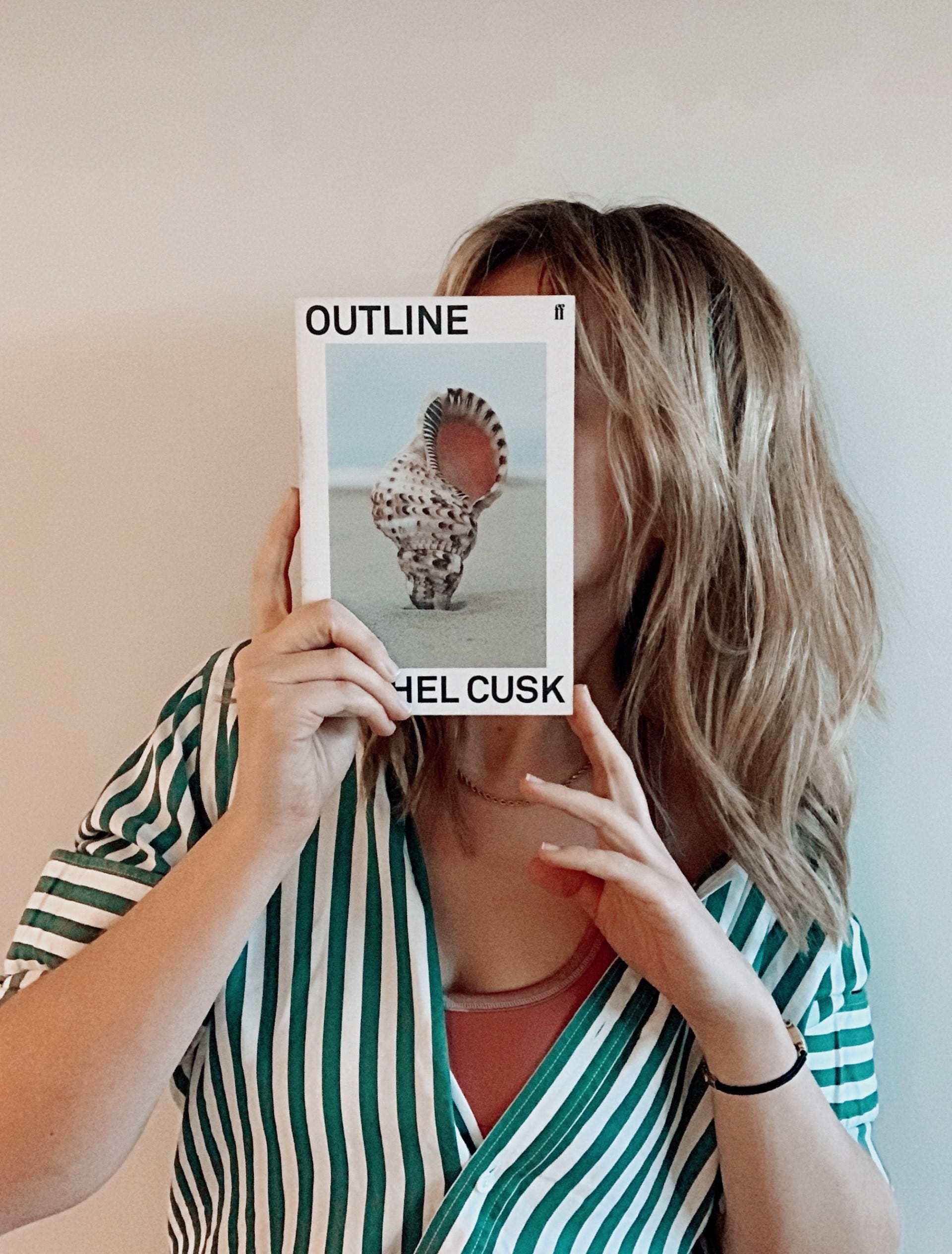
What solidified this reflection for me was my desperation in reading and wanting to like Outline by Rachel Cusk. I’ve read a series of similar ‘monologuing’ writing styles over the summer months; while Outline was the most on the nose with this technique, Yellowface by Rebecca F. Kuang had a similar long formed talking to the reader style and suffered a similar fate with my distaste whilst reading, and to some extent The White Album by Joan Didon (although, more journal style than inner/outer monologue) also was an unhappy slog to the finish line. But the truth of it is, they have all since been a constant nag in my brain.
If the thought of reading consistent verbal and inner monologue, without much brevity for action, sounds too much of a headache (and I don’t blame you if it does) then Outline probably isn’t the book for you. Having said that, if you fancy something philosophical and self-reflective then there’s not a better book than this to get existentially sunk into. If you’re a contrarian like me, you will very much love/hate this book.
Firstly, you should know I picked the book based on two reasons alone: one, it is set in Athens, a country and culture I was eager to immerse into, and two, the cover is so crisp and gorgeous I was a magpie before I had a chance to think twice. Perhaps this way of book shopping is what leads me to bitter disappointment, but I doubt I will stop buying this way.
Whilst the core concept of Outline is learning about the characters through their conversations with the protagonist, Faye, I in fact enjoyed (and indeed learnt more about) the characters more from the small snippets of interactions with their surroundings. The descriptions of Greece, the scene setting and activities taken up by Faye were much more thrilling and imaginative to read than the long drawn out, and often overly self-indulgent, mini spoken-autobiographical accounts. A particular chapter springs to mind, where Faye has dinner with a friend and a famous female novelist at an ‘unfashionable’ restaurant in the center of town. Here we are introduced (fleetingly) to Angeliki. It is not her page(s!) long speech on the industry that capture me, but in fact the way her character plays within the scene, so full bodied and colourful it breathed life into the entire setting and the snapshot moment within it. From the minute she arrives at the restaurant, how she interacts with the waiter, her wine and food, with Faye and her friend, how she moves her body, smokes a cigarette, to the moment she leaves, Cusk was able to carve out a stunning visual in impressively few words, but was unfortunately a chapter that felt far too short and sweet for such a complex character.
Despite my issues with the writing technique, I’ve noticed in going back through the book for quotes that I had thumbed down quite a few pages which had spoken to me, one in particular folded down and highlighting (rather randomly) an analysis on the haunting nostalgia of music:
‘Music is the betrayer of secrets; it is more treacherous even than dreams, which at least have the virtue of being private’
And another which had perhaps my favourite quote of the book, hit home most unexpectedly and has plagued me relentingly:
‘[… ]I was no longer interested in literature as a form of snobbery or even of self-definition […] in fact if I read something I admired I found myself increasingly disinclined to mention it at all. What I knew personally to be true had come to seem unrelated to the process of persuading others. I did not, any longer, want to persuade anyone of anything.’
The concept goes further in it’s cleverness, by allowing the main character to confront her own life through the intricate tales of others, but the pompousness of the speeches were unrealistic and hard to grasp as to what lessons were meant to be learnt. Let alone it was a stretch to imagine that any one person could sit through another talking about themselves with such one sided speeches. I suppose it’s the intended nature of being set in Greece which explains the constant state of philosophising that each character seems to have adopted as a characteristic. It’s clever (perhaps too clever?) but often means that the characters mold into one. Perhaps, this is Cusk's intention; they are all a reflection of Faye rather than their own individual identities. This left me with the final conclusion that if every page has some sort of profound realisation, then as a whole the book loses all meaning of an epiphany. It pulls back on the punchiness and ends up a little weak.
Having said all this there are some characters I did very much enjoy and felt they were strongly thought out, these tended to be the older, grittier, most flawed female characters. Cusk’s writing style is it’s strongest here and I could read a whole book about Angeliki or Marielle (a middle aged student attending Faye’s creative writing class, who I imagined wafted in with silk scarves and a plummy perfumed scent), and I would love to have seen them explored more.
In fact I found all the female characters so much more interesting than their male counterparts, to the extent that even the women as told through the anecdotes of the men, were much more rich and interesting to me - which I can’t ignore whether this was completely intentional by Cusk.
In the end I truly think Rachel Cusk is an excellent writer, I just think as a premise this missed the mark for me as a reader.
In general, I’ve been pondering for a while on why there is such an influx of this style of writing, until a girlfriend of mine mentioned she envisioned Yellowface as a Fleabag-esq show, which nailed it for me. A similar book last year was read in book club - How To Kill Your Family by Bella Mackie - this too had traits of the Pheobe Waller-Bridge ‘and pause for knowing look to camera smile’, tongue in cheek, inner thought style. This works, for me, as a show but unfortunately can be dull, a little conceited and often takes an unfortunate turn in to the realm of priggish when in book form - at least this is true of the books I’ve read.
Another jarring feeling I got from each of these books is that they screamed: ‘this will definitely win some kind of literary award or accolades in the publishing world’. I get it, they are different, whimsical yet edgy, and highly intelligent, but does this mean it’s actually enjoyable to read? I’m not so sure. And is the point of a book to always enjoy the read? I think the fact they’ve each stuck with me in their own way provides some testament that this might not be necessary. I’ve never understood what the phrase ‘love is a battlefield’ meant before, perhaps this is it.
The irony is also not lost on me (as this monologued writing draws to a close); it could be argued my blog itself is of a similar ilk. Here’s hoping you, dear reader, are more a fan of this style than I!