

How is it we seem to know a witch when we see a witch?
It’s something almost inexplicable but is a gut instinct that women seem to know when they behold a witch - and this isn’t an insult, it’s an empowering thing. A name which we embrace and feel a kin-ship with. More times than I can count, myself and the women in my life have uttered the words: ‘We must be witches!’. Usually when we’ve experienced similar intuitions, expressed thoughts in unison, or have been thinking about someone only to look down at your phone and realise they’ve already reached out to you. Does this mean to be a woman is to be a witch? (‘Witch’ being, for want of a better phrase, a word to describe such intuitive, kindred beings woman can be.)
Much the like people, time periods also seem to denote a ‘witchy’ vibe. The 70’s for example is definitely a ’Witch Era’, think unkempt hippy hair, free spirited inclinations, women’s right, Stevie Knicks - an obvious witch. Back as far as Ancient Rome and Egypt oracles are sort after, rituals and rites tied intrinsically to the afterlife are passionately followed, curses and of course Cleopatra, a perceived witch with style, passion, intelligence and power. Medieval England: ranging from a deep rootedness in traditional folklore and echoes of former paganism, to the accusation and execution of Anne Bolyne, The Witch Finder General and his crusade against witches of Essex, to King James and the witch trials of Scotland. Greek Mythology: looking at you Circe (and of course I have read and loved the godly, dreamlike trance state that is Madeline Miller’s novel about this very witch). Pilgrim America and the infamous Salem witch trials. Eccentric, aristocratic Victorian’s, wiling away their gothic obsession mixed with neo-rinacansse art, were witching away in their delapatated manor houses surrounded by lush sprite-enticing gardens, leading to a time of dark arts and fairy-like magic. All these time periods I can point a bony finger to and claim witch, but for me the strongest of these witchy timeframes was the 1990’s.
Perhaps the 90’s child in me was always destined to be infatuated with witchcraft. I have hazy memories of the flat my dad owned when I was little, to me there was always something witchy about it. Firstly the music, influenced by my dad’s sister in law (who possibly was the first woman I ever identified as a witch), whom he had always attributed his eclectic music taste to, including some particularly spellcasting music from the likes of Kate Bush to The Cranberries. The decor I see in my minds eye as earthy, full of plants, tie-dye and dark stained wood, decked out with trinkets from travelling - tribal & wicker. It felt like a home for the spiritual. My memories flash through with an amber film and wispy incense. I’m not sure my dad ever liked incense, and probably influence from Polaroid filters has clouded my pictural memory, but there is something so mystical about the 90s that I have never been able to shake.
It’s obvious too that commercially witch culture was eminent at this time, and certainly had its influence on me. Name a Millenial girl who wasn’t infatuated with Sabrina The Teenage Witch, Worst Witch, Charmed, Practical Magic. Not to mention the unavoidable book of the decade Harry Potter! Even the 90’s style conjures up a hocus pocus vibe; if grunge isn’t a 90’s take on the witch iconography, I’d eat my proverbial pointy black hat. An interview with The Corrs sisters totally engulfed me as a kid, so enthralled was I by their long dark hair, whispering Irish accents and hauntingly charming folksy-pop music; it was a coven before my very eyes. This era winks at my nostalgic witchy soul with every crystal dolphin figurine, evil eye amulet, every furling pack of tarot cards strewn upon a brown carpenter crafted coffee-table, tangled web dream catcher and windchime chiming (as one might expect) with a tinkling and clanking mixture of bells and wooden notes.
Or perhaps it’s my natural urge as a Scorpio to be obsessed with the darkness? Born on the second day of Allhallowtide I feel a kinship with this daringly seductive and scandalous ‘other’ world. Of course with my birthday being always intrinsically tied with Halloween, I felt a special spiritual connection to the holiday. I can fondly recount a particular birthday eve watching Hocus Pocus, surrounded by the lit pumpkins we had carved days before, a crispy bitter chill pouring in from the open front door illuminating goulish kids screaming ‘Trick or Treat!’, a tingling excitment all night knowing the next day would be my birthday. Halloween belonged to me, a secret connecting veil tie us together, one only it and I are aware of. My meek and cowardly initial response to life is always twinned with a quiet yet desperate curiosity to roam within a troublesome realm. Not to be in trouble, but to be troubling. Not to face the eye of the storm but to be the hurricane itself. This is my inner Scorpio witch.
There is of course the undeniable feminine urge within me; women wax and wane alongside the moon, our cycle so in sync with much of nature, reflective of the seasons even, the constant circle of four quarters. Something so obvious and yet mysterious, the intrinsique ties that seem so uncontrolable and powerful at once. We women, who have the ability to grow and carry our daughters own eggs within us, are so physically linked to one another and to life itself that it’s no wonder we fascinate, grieve and relate to women of the past; those who came before us who were so needlessly killed for a dark magic they didn’t possibly possess. But of course it was a kind of magic, not the potions and finger tips sparking with curse kind, but a feminine power that was feared. When I reimagine my female status in this way, I feel like magic personified.

Whatever the reason, I’ve always been hooked by this spiritual other - perhaps all bookworms are, it is why we so easily fall deeply into a story. What’s more magical than using your imagination to breath life into to the words strung together by a stranger upon a piece of paper. Reading about witches in particular is a fascinating topic as there’s always a choice between fictional fantasy and factual historical accounts - both of which are equally captivating.
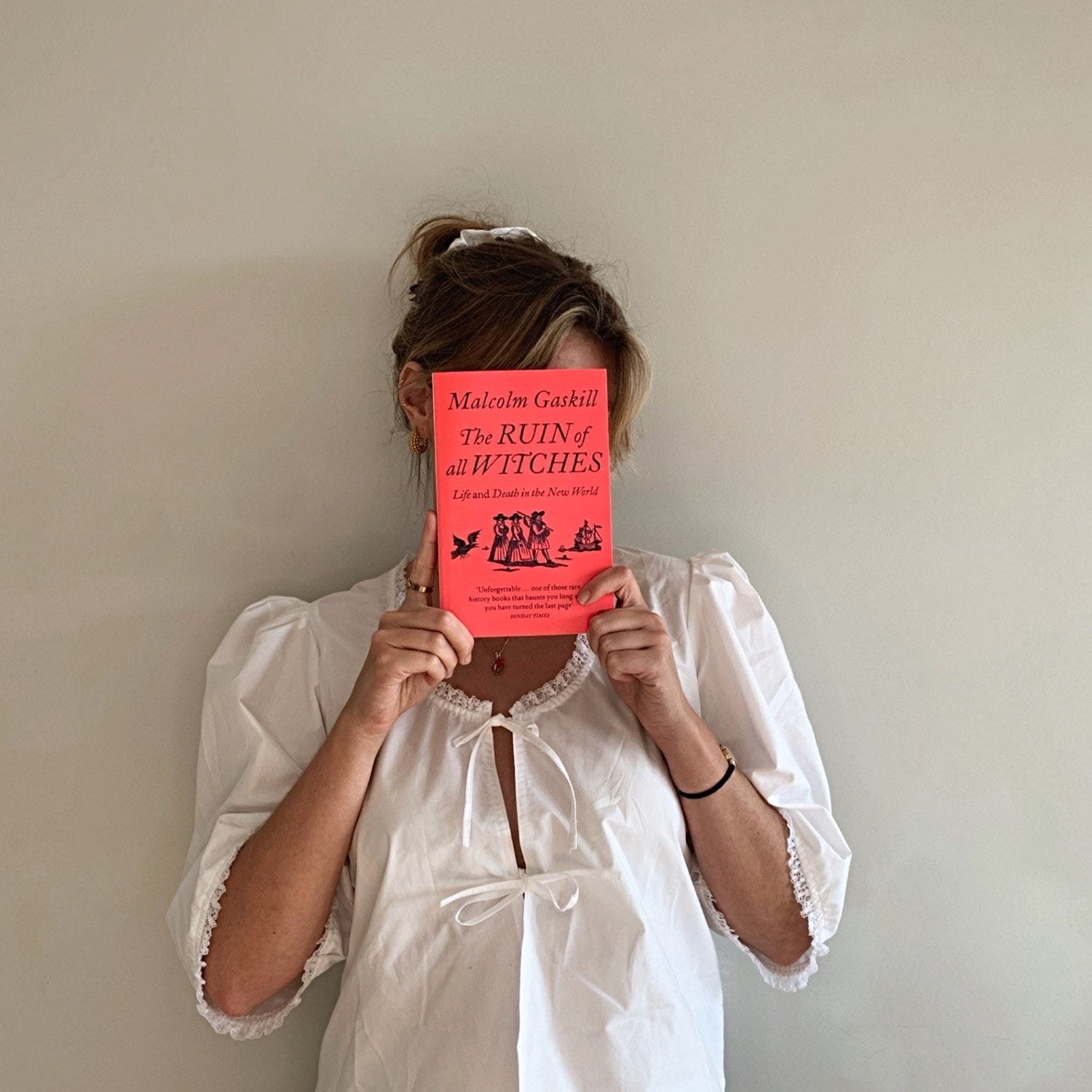
In my latest read, The Ruin of Witches, it describes witches as the ‘tangible symbol of this chaos’ - ‘this’ referring to the crazed cultural climate, influenced by the unsettled political and social-economic upheaval at the time of the colonialisation of American and the pilgrim’s escape from pre-civil war England. Chaos, of course, was something of a disaster at this time and thus witches were the personification of such an uncertain and dangerous world. It truly is a privilege to now reframe the word ‘witch’ as something powerful, and reclaiming it’s meaning, when originally it was used to demonise and weaponise in such a life-threatening way. But is this a reclaiming of the word the reason why many women (myself included) are so drawn to the subject of witches? And why we are so keen to be recognised as one ourselves. To me, witches are in fact a symbol of chaos, but in this reframing the synonym of chaos is freedom.
It is this topic on witches in the real world that I pick over any other witch narrative lately. Whereas the magic of all would’ve enthralled me once upon a time, I have found increasingly it is in fact the realism of it all that I am now drawn to with books. I recall a book, Witch Child, which I remember excitedly as a young girl thinking was a period-piece set tale about women practicing actual witchcraft, only to find that the magic the character’s were accused of were in fact brewing a basic herbal remedies, or being coincidentally in the vicinity at the time of the death of a rabbit. The story disappointingly (at the time) was less sorceress and more source based, about those who are prosecuted unjustly and punished by their time as a women, a poor person, or an unwanted immigrant. What had sunk my heart so then, is now a story I simply cannot get enough of, and in fact find even more power, inspiration and charm in the realism of being a woman in such a historical context. In fairness this book was probably the first YA tale I knew of that dealt with this subject in such a realistic and grown up way, and perhaps without this enlightenment I wouldn’t have been incline to investigate this narrative further.
The Manningtree Witches is a more evolved take on this type of narrative, it presents an even more realistic reason behind the prosecution of women as witches. My love of this book was increased further when listening to Witch a podcast on BBC Sounds (forgive me for expanding my recommendations to beyond books here). I am struck in particular by the discussion on the types of women persecuted, and which social issues, and political and religious inconsistencies infiltrated communities and perpetuated the rational behind the witch trials. One thing I found fascinating about this podcast was the ability to mix witchcraft with the true historical understandings. One episode dives into the type of woman othered as a witch, and highlighted to me a curious modern stance on witches. Pop-culture has created an unusual portrayal of accused witches which has exaggerated and culturally influenced ‘truths’. For example it is a modern take on the truth of witch trials that those persecuted were strong-minded, independent, powerful women, a healer (perhaps a midwife), or a young chit who is flirty and dangerously beautiful and that the accusation are all driven by the crazed male gazed desire and fear of women with the aim to stamp them in line. While it is true historical and rigorously entrenched misogyny played a part in these persecutions, the truth is most women prosecuted were middle-age - older women, women who found themselves alone not by choice but by the changes of law and land (left destitute, not empowered), and in fact the link between midwifery and witchcraft is without real evidence.
While it makes for a good story, I wonder why we ignore the less ‘glamourous’ tale for a more punchy enthralling spin on the truth - this in itself feels a oversight and injustice to the suffering of women. That being said, I’ll be the first to say I am engrossed by the ‘sexier’ version of events, and I think it’s such a popular myth because it runs a parallel with modern female strife’s, this allows us to feel not only empowered in our own time, but closer to our troubled sisters in the past. If you love the idea of historical witches I think there is nothing better than a tale set in Scotland: Corrag is a great book set in the heart of witch-hunt times. But if you want something unexplainable with a theme of ancestorial connection, then out of all the witchy books I’ve read this season, The Winter Sea might be the autumnal book to reach for.
Lastly, it’s worth touching on the concept of the ‘bad witch’, the evil, scary witch from fairytales and horror stories, because of course there is nothing that is wholly good or wholly bad, and stories of dark twisted characters brimming with maledictions and desires to rain dark incantations are salaciously appealing, particularly this time of year. If you want to go full witchery with a book, one that is pure story and exciting magical action, then I would recommend fully immersing yourself in the parallel medieval world, full of terror and evil, of Uprooted; the best book I’ve read this year.
Many things in the world are enchantingly mysterious and spiritually unexplainable, I feel there’s something joyous and harmonious in that. We should (and some extent now do) celebrate this veiled realm. Nothing is more humbling nor more exciting than the unknown mysteries of life, there’s nothing that brings us closer to earth, or the meaning of our being, than the shadowy folds within reality, where I believe a kind of magic pulsates and grows. Perhaps this is the womb of the earth, where woman is grown and where witch is born.