


My insatiable appetite for reading has resulted in becoming a glutton of a reader. I consume books in what can only be described as inhaling its content, I want more, I want it all, I need to finish and move on and munch my way through my read list like a literary packman let loose in a world of words. And yet, I think in my excitement my way of reading has completely shifted, not only what I read but how I read, and has made me question how healthy my bookish appetite has become.
As the first born, eldest daughter, my sense of worth comes from completing tasks (and bonus points if in a competitive scenario), receiving praise for a job well done and, let’s face it, the thrill of being a bit of a know-it-all. The dopamine hit I will get from not just finishing a book, but ticking off my progress on Goodreads and proudly stacking up all the books I have already conquered, was startlingly compulsive. Enter the book slump: because, of course, when the end of the journey becomes more important than the experience then I’ve missed the point of reading in the first place and I either cannot concentrate on a book, or my diet has indulged in too much easy-reading slop. It never used to be this way. I remember reading for the thrill of it, for the heady high I would feel diving into another world and seldom coming up for air because I was completely enthralled. Partly I suppose it is the reality of adulthood, but I would also like to lay blame at the door of contemporary life, or more specifically, contemporary distraction.
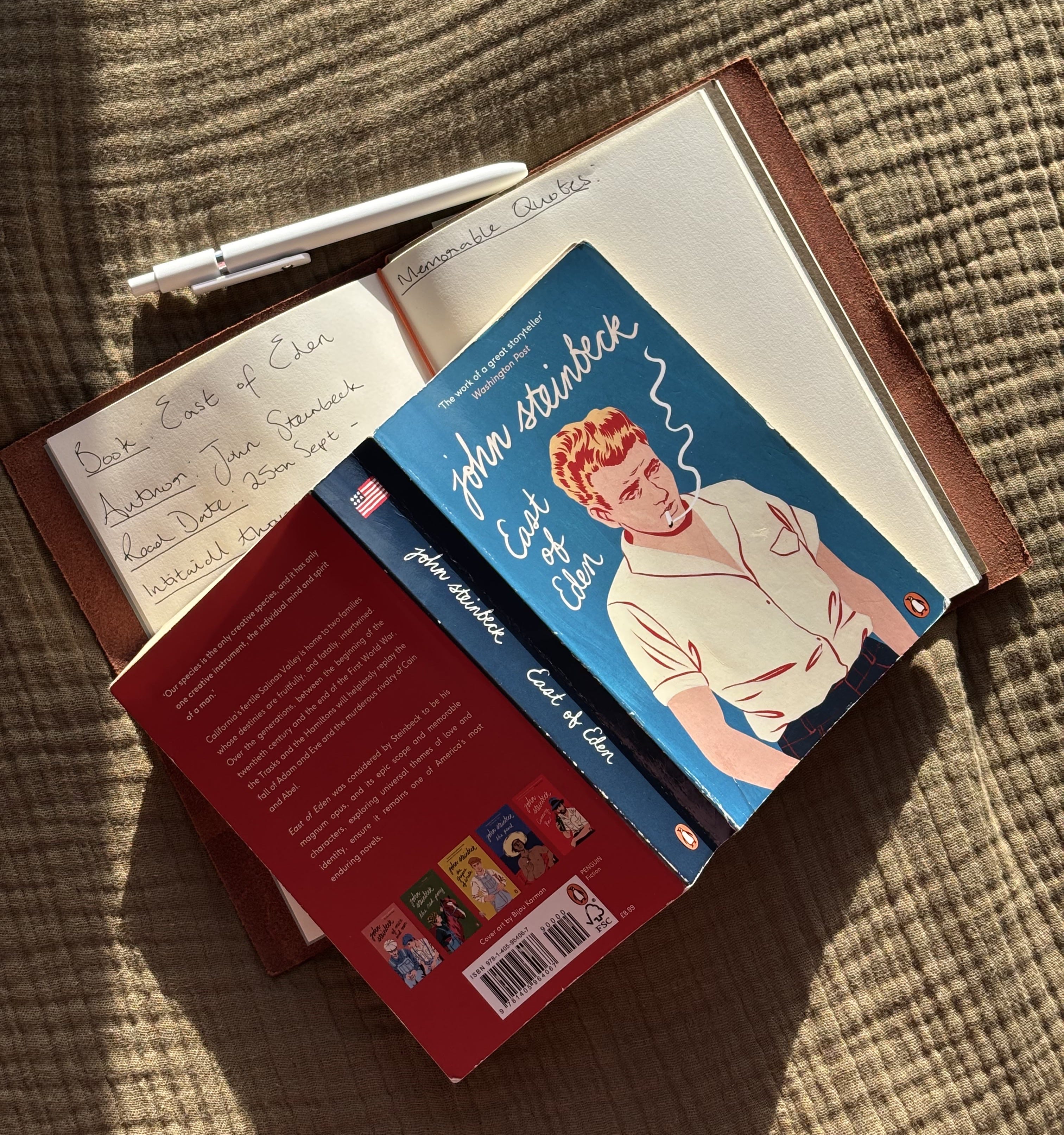
No other book has highlighted this struggle between conscientiously reading an epic tale and the siren calls of modern-day life, more so than me desperately trying to read through East of Eden.
The problem is, I can’t stop thinking about Florence Pugh.
I’ve equated her with Steinbeck’s Cathy without even finishing the book nor watching the show. I so desperately want to be part of the zeitgeist conversation that I thought it was plausible to start and finish reading East of Eden within a week of the show starting (it’s 700-odd pages, in case you didn’t know, and the tiniest font only the bible can out-compete with). I wanted to be a purist and review the show critically, having consumed the original text myself, and form my own interpretation of the book as a foundational knowledge prior to watching the show. I prided myself in being a true reader and an honest reviewer, in this approach. A month in however, and I still can’t finish the damned thing, and I can’t stop thinking about Florence Pugh.

With each sentence I read my mind wanders to the few clips I’ve seen online, imagining the way Pugh would deliver each Cathy scene; Netflix keeps shoving it’s suggestion to watch it down my throat, with every pretty but vaguely ominous picture of Pugh dressed ever so ascetically pleasingly, yet somehow ridiculously cool, in period-costume. With every breathtaking description of the virgin Californian landscape, I so desperately want the visuals flashed right before my eyes rather than attempt to conjure the wondrous vastness within my own brain. I want to open up instagram and inhale all the press tour, deviate to Pugh’s promo outfits then jump from that to the Sense and Sensibility press tour and salivate over those ethereal clothes instead; (1) if I read one more sentence on how to find water in the abundant new western land then it’s another drifted thought towards The Book Club podcast I’ve somehow simultaneously started listening to, who have decided to highlight East of Eden as the book of the week and has now stained me with their own thoughts on the book; or the reels upon reels of opinions on whether Cathy is morally bad or simply misunderstood is just the right about of online drama that’s too enticing to avoid and to not let slip into my reading of the text.


(1) And oh, by the way, have you seen the new S&S film, because I have and I loved it and I don’t care if Austen purists hate me for that because no, of course, I did not have the time to read the book before watching the film and I’m sorry but I am more of a film-Austen lover than a book fan, because, again, those books are just. so. slow!
I’m struggling to read a book nowadays without the thought of others crowding up my brain. I can’t take in a text and let it form within my own thinking. I’m constantly influenced by the thought of others in a way I never was before.
Back to reading Steinbeck, and my eyes jump over the page. I can’t fathom this strange language that is without clarity and seems to constantly be dripping in a hidden meaning or depth I should be tapping into. Don’t mistake me in thinking that this type of writing isn’t something I love. It is! I just don’t know if the issue is Steinbeck's voice or my inability to concentrate on something so hefty in substance and meaning, when I have a pool of story-adjacent entertainment to dive blissfully into. Is the story’s beauty in its simplicity, or is the story just boring me? Is the ‘great novel’s’ purpose to challenges us or entertain? Ideally, both. It’s a question I’ve been thinking abut a lot. Certainly it transcends time and speaks to the reader regardless of century, it connects on a human level, but should a reader be working this hard to feel as though they’ve been spoken to?
The sheer size doesn’t add to my desire. It’s not so much the thought of getting through it but more so the overwhelming feeling I get of knowing it is keeping me away from my ever growing stack of unread books, which in turn brings me out in hives at the thought of the impossibility of reading through all the books there is to own.
And then, suddenly you see a sunrise. Or the description of a fertile land bathed in moonlight. Or a single precious thought on what it means to love and live and survive, what makes humans both dreadful and wonderful. Or a burst of intense action, in what has otherwise been the dullest read, and I am back on board with continuing through the remaining three(!) hundred pages.
I’ve made the decision to see this relationship with East of Eden through. In this age of brevity, I am a champion of long form content, its importance to be honest, nuanced and attempt at being understood whilst tackling with the complexity of the world. My wrestling with its pages has shown me the importance of slowing things down. If it’s core story is the search for contentment in the simple life, then the process of reading it is teaching me that in abundance. Life has sped up at an alarming speed: forced to endure Christmas commerce in summer, a social media rushing us to keep up with the newest trends and doing so in the most intrusive of ways, the viral books to love or hate and finding the time to read them all and then respond to it all in an immediate fashion, a fear-mongering culture that doesn’t allow any joys of the present - the constant misery onslaught of a doomed future and an unforgivable past…
If reading East of Eden has taught me anything at all, it is to just be. That’s not to say I can’t be reflective, or forward thinking, but is more about the art in doing so in a timely manner. To sit with it awhile. Before consuming the next piece of media.
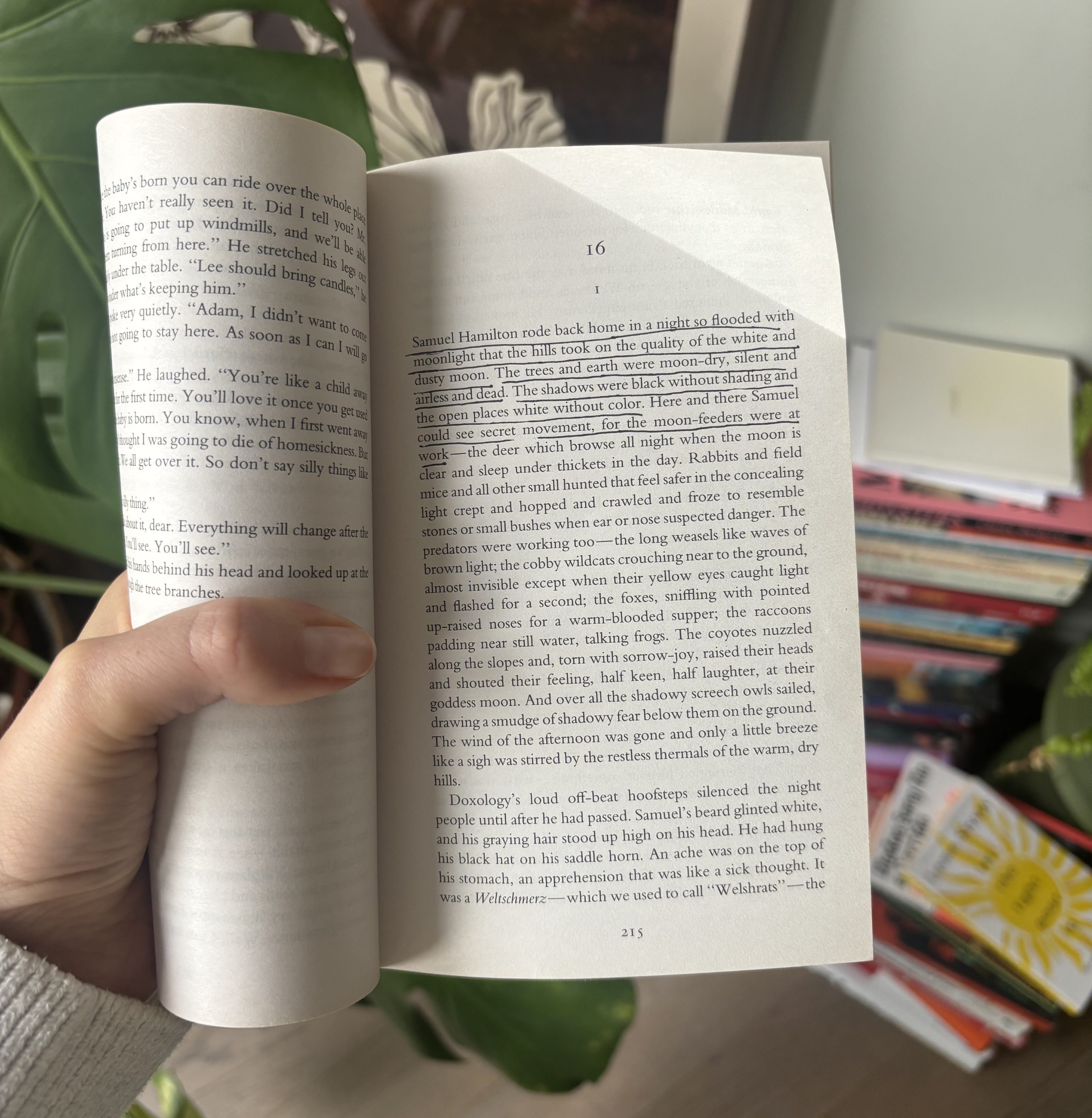
In my fight back, I’m making a conscious decision to change my approach to reading. Or more accurately I’m taking myself back to the way reading used to be - a more analog, a snail-mail kind of place in time. Where instant releases and binge watching (or in my case binge reading) wasn’t a thing.
And so with this in mind I’ve set myself some new rules to really embrace the art of slow reading:
I will not let tv show adaptations rush me into reading/finishing the book. By the same token, I will not pressure myself to read said book at all, just because there’s now a film of it.
As a reviewer, I will accept my opinions on books are uniquely my own and are no less interesting even if I am behind the curve on when the book was once popular. I must resist the pressure to jump on a trend in order to stay part of the conversation. I’ll start my own conversation and find my bookish people there.
If it’s a deemed a must-read, it might not be a must-read for me and that’s ok (see previous note on fear of being out of the conversation).
Not feeling guilty about reading only one book a month (or over several months, or no books at all!), learning it’s ok to pause and read a different book or to abandon a book altogether.
I will balance reading for entertainment with reading critically. Approaching instead with the lens for my own edification but to read because I want a good story.
I’ll become an annotator once again, a page folder, an emphatic discusser of what I’m currently reading. A fast reader cannot pause to muse.
And because my content creation focus is the reviewing books, I’m introducing writing a book journal into my life, to force myself to decelerate my reviews and sit with the book for a little while. Put pen to actual paper, the act of this tangible nature bringing me back to the present, rather than spiralling down a hole of virtual reality.
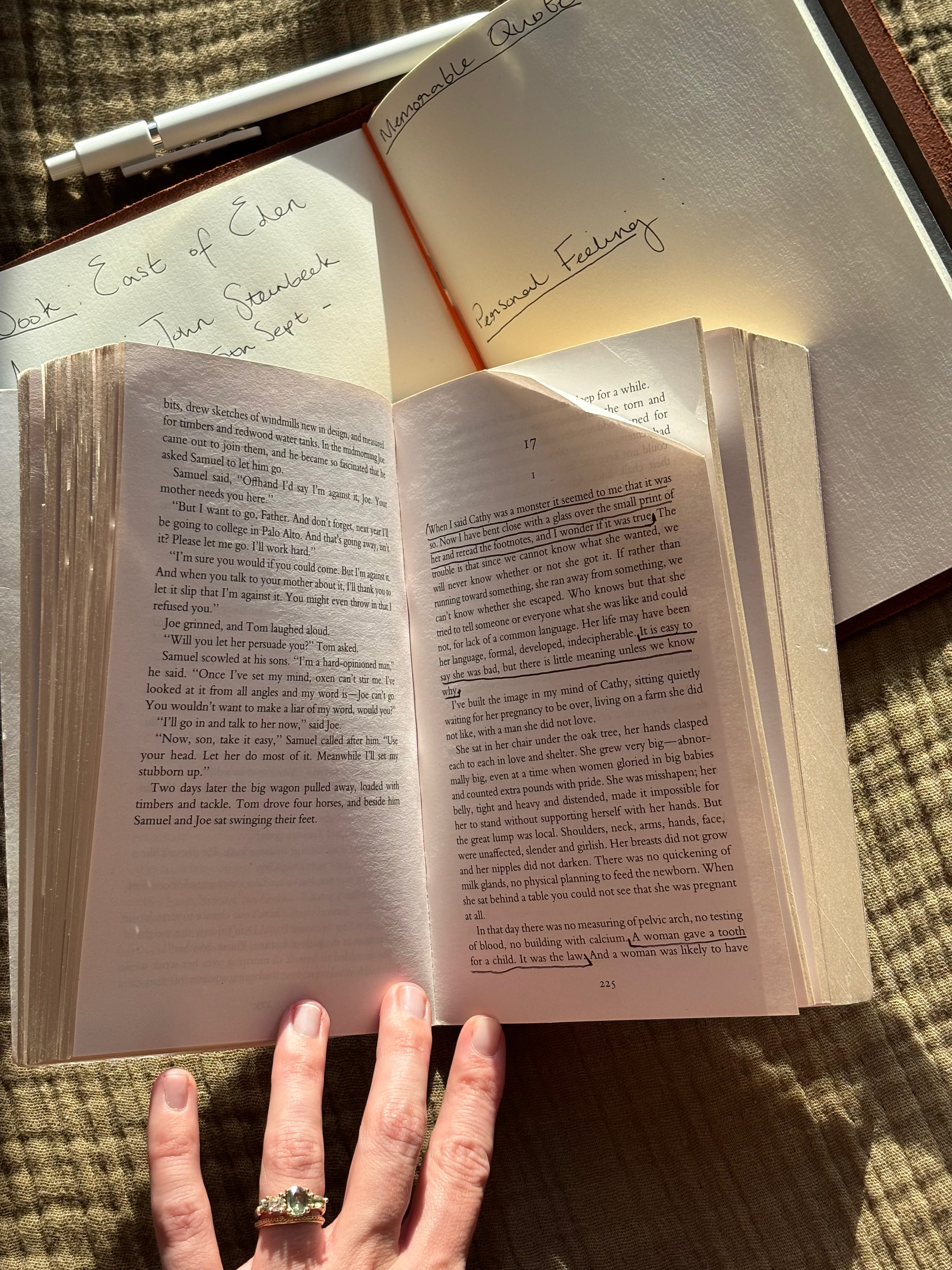
As tricky as I am finding East of Eden, I can’t seem to leave it alone. I think it goes beyond the pressures of it being a ‘must read’; it’s something more personal than that. I want to know what happens to the characters, where the story ends. Perhaps the thing I’m most afraid of is putting in this hard work and finding in the end, there was little profound meaning at all. That can’t be right, can’t be true, it’s a legendary book for a reason and we can’t collectively be blown away by a lame duck, can we?
Whatever the end reveals, I am learning to enjoy the journey. It’s ok if it’s taken me almost a month to get half way through, and that makes it ok that the many other books I am dying to read have been gathering dust for a while. I’ll get round to it, there’s no competition or race I am participating in. I won’t let the possibilities of life spoil the moment I have with East of Eden, it soon will end and a new beginning will dawn, a new book will be read and hopefully my soul will have expanded and altered.

The Goodreads tick is such an honest detail. Once finishing becomes the reward, the book turns into a task. I've noticed the same trap in self-study, where completed courses feel like progress. One thing that helps me is counting what a book changed in my thinking instead of how many I got through. A slow month with one good argument beats ten skimmed ones.
This was a really interesting read…I’m still ploughing through East of Eden and not enjoying it! Will persist